Welcome, Premières! This blog will help us communicate, share ideas, and create dialogues outside the space of the classroom. It will be a convenient way to learn about assignments and schedule changes, and will also include helpful background documents and links. I look forward to getting to know each of you online.
Friday, January 28, 2011
Sonnet responses!
What are your impressions of the sonnets? After reading the entire packet, what is your sense of the form and its adaptability to different themes? Are there any particular sonnets that appeal to you more than others?
One of the prevalent themes I noticed in the sonnet packet was the presence of deep emotion. Whether the sonnet be about love, death, life, all of the poets offer a window into their emotional view of the world. While it is a strictly subjective view of the universe, the reader feels drawn into the sonnet and slips into the poet or narrator's shoes for a moment. These sonnets offer emotion so deep that the reader cannot help but empathize and feel as the poet does. I especially noticed this in "Harlem Dancer," by Claude Mckay. While the majority of the sonnet focuses on this beautiful and entrancing figure's appearance, the last lines offer deep insight into her soul and feelings. The reader can feel her unease and the unhappiness so in contrast with her vivacious and twirling body. The last couplet completely embodies the dancer's feelings, and its few words can portray her emotions. This was one of my favorite poems of the packet, not because it was more modern, but because the main figure was so gripping. The image of a entrancingly dancing woman who is completely detached from her situation struck me hard. The way that Mckay describes her with a sadness only visible through her eyes makes the reader want to empathize with this trapped woman even more, to help out of the situation. Whether it be temporary or permanent, the woman seems to be torn by what she is doing. While Claude Mckay is my favorite of the sonnets that we have studied, I noticed this deep set emotion in all of the poems in the packet.
Making a parallel between “The Harlem Dancer” by Claude Mckay, and Rossetti’s “In an artist’s studio” is something that I haven’t thought of before, but in fact, it seems to me very interesting to think about how those two poems complement each other in a certain way. Although Mckay and Rossetti represent and picture a total different scene, both of the poems have quite a strong link. In my opinion, both of the poets are criticizing in their writing the objectification of women. Rossetti presents a situation where an artist paints exactly the same perfect girl in all of his “canvases”. Here, the artist paints a woman whose name and personality are unknown, as the poet refers to her as a “nameless girl” l.6. The painter represents her as he wants but “Not as she is” l.13-14, first of all because he doesn’t know how she is, and second of all, because the artist is making up the image of this nonexistent woman in his mind. This suggests that the woman is for him an object, that he is painting with “the same meaning” every time; even though Rossetti pictures all of the different representations of the woman for the artist she is still the same, which also leads the reader to think that she is an object giving the fact that she never changes, she remains still and intact. To add, the fact of idealizing her, supports also the idea of presenting the woman as an object. Here, the woman has lost the human signification and is a “saint” or an “angel”, something that is only useful to the artist to paint, and to “dream” about. Idealization loses all the human meaning as it goes on with the idea of painting something that doesn’t exist. This is emphasized by the fact that the artist will never find that perfect woman, and she will always remain a purely invented object, again with “the same meaning”. This objectification of the woman is also present in a more explicit way in “The Harlem Dancer”. Here, Mckay presents a scene where “applauding youths” are entertained by “prostitutes”. By reading the first line of the poem, the reader can already speculate about the superficial society in the early 20th century where the woman was clearly seen as an object, as a simply entertainment for men. As “In an artist’s studio” the woman is presented as a way of evasion, here, too, the “half-clothed” dancer is overall only a way for men to be amused. The poet refers to the dancer’s body several times, “half-clothed body sway” l.1, “her form” l.6, “shiny curls” l.9, “falsely smiling face” l.13. Here, the diction of the body opposes the superficial side of the audience, who is only marveled at the woman’s external beauty, to the poet’s vision of this woman. In fact, for the poet, the dancer has another meaning; she is not as the other “prostitutes”. We can say that her body contradicts her internal self. Indeed, the dancer is presented in a natural environment (“picnic day” l.4, “proudly-swaying palm” l.7), that has nothing to do with the “storm” she is passing through. However, the audience is blinded and only sees her body and her “form”, which means that even though the woman doesn’t feel herself a “prostitute” the others see her fundamentally as that. This comes back to the idea of seeing the woman as men want but “Not as she is”, as Rossetti claims in her poem. The fact of “tossing coins in praise” l.10 can also suggest how for the audience the woman is a simple “machine” that will give what the men want by putting money inside it. We can then say that Rossetti and Mckay, both with different tools and approaches, present the woman purely as an object with the only purpose of pleasing the man. Hence, the critique of the woman’s objectification and dehumanization in both of the sonnets.
I perceived the role of the contrasting poems chosen to make up this sonnet packet as one based on revealing the sonnet’s adaptability – not only to different themes but also to less rigorous structural patterns. I felt the purpose of the first four sonnets was mainly to establish the different types of more “traditional” sonnets – Elizabethan and Petrarchan – each with 14 verses, a strict meter and calculated rhyme schemes. The themes – often something along the lines of time’s ephemerality - found in these sonnets are also very specific; in his sonnet #73, the narrator instated by Shakespeare speaks of his life as being on “the deathbed whereon it must expire, / Consumed with that which it was nourished by” which reminds the reader of the briefness of time and life, which eventually comes to an end. In Shelley’s “Ozymandias”, the simple sentence “nothing beside remains” brings forth an element of situational and cosmic irony which allows us to conclude that even the great creations of “Ozymandias, King of Kings” will suffer destruction, like everything else of a lower rank. Finally, in Keats’ poem, his narrator fears dying “before” having done several things; his worry and concern about the passing time is mainly shown by the repetition of “before” and “never” and other time markers throughout the poem. In my opinion, these themes are rather personal and draw the reader in. Consequently, I must affirm my agreement with Millie’s statement: I too think that one of the elements that tie all the poems of this packet together is this intimacy of the themes of the sonnets. Be it through the “I”s and “me”s in Shakespeare’s sonnets #29 and #73 or the mention of feelings and expressions such as a “sneer of cold command” in Shelley’s sonnet or Keats’ mention of “love” – also expressed by a narrator who establishes a rather intimate relation with the reader through numerous “I”s and “my”s. This personal feel is continued throughout the following poems: in Christina Rossetti’s sonnet there is a mention of more personal themes such as “hope” and “[dreams]” as well as smaller details which offer a feeling of proximity with the narrator and the story. In Seamus Heaney’s poems, the narrator describes banal activities in intimate ways, such as “[peeling] potatoes” in his poem Clearances #5 through which he incorporates the element of love, expressed by “I was all hers”. In his other poem Clearances #3, Heaney also mixes a feel of intimacy through the designation of a “her” who he undertakes the task of folding sheets with; his description of “ending up hand to hand” turns their commonplace chore into a dance. In Mckay’s poem, the reader is presented with the rather personal themes of passion and desire brought forth by the “Harlem dancer”, the main subject of the poem and the lascivious description of her “perfect, half-clothed body”. Last but not least, in Rita Dove’s poem, the narrator mentions feelings – such as “feeling unnecessary” – and sights which make up a personal, emotionally involved vision of Paris. Thus, thought the themes vary quite largely from sonnet to sonnet – especially through time – at least one aspect of the “structure” of the portrayal remains. We can also note that though slightly distorted from its original state, the sonnet’s form of 14 verses is more or less conserved as well.
My favorite sonnet of the packet is From Clearances #5 by Seamus Heaney. This poem is straightforward and has a simple message but is very rich at the same time. Every time I read it, the poem seems to get deeper as I discover details I had not seen before. Heaney, through this simple and humble event, that of peeling potatoes, remembers his mother and his quotidian spent with her. These are, of course, events that will no longer be since the poet says that she is dead: “So while the parish priest at her bedside went hammer and tongs at the prayers for the dying...”. Moreover, I found the way the poet combined the imagery of death with the almost mundane act of peeling potatoes to be interesting. The poet is absent from the scene occurring under his eyes: the priest, his dead mother’s body, “ and some responding and some crying”. Instead, he is remembering this event that at the time must have seemed trivial and of very little importance for both the mother and the son. This is what I think is beautiful about the poem and the message it gives the reader: it is the quotidian you remember, the quiet day to day love, the simple thing you thought you would never remember, being there for each just by peeling potatoes. It is not a poem expressing grandiose souvenirs or horrible sufferings because of someone’s death; it is, on the contrary, much simpler. Indeed, the poem's structure, for example, shows that the poet is not bothering with something as superficial as rimes. His souvenir is so simple and humble that hiding behind something like a very strict form might ruin it’s sincerity. In fact, this is why the poem is so immensely touching, because the reader can relate to it, because you can imagine yourself missing “her head bent towards my head, her breath in mine, our fluent dipping knives-never closer the whole rest of our lives”. The everyday life is what brings you close to someone and what you miss the most when the person is gone.
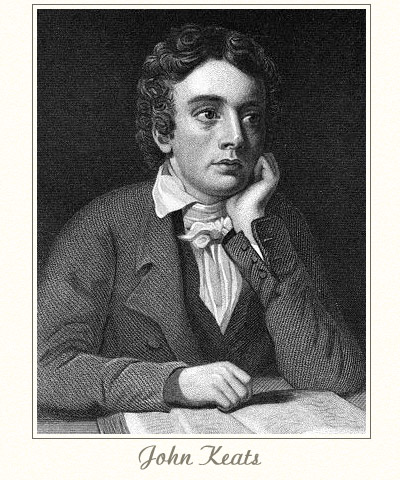
My favorite sonnet would be “When I have Fears that I may Cease to Be” by John Keats. I enjoy this sonnet because it is original and the poet seems to change his mind towards the end of the poem. This poem is original because it uses an agricultural metaphor as an image to show the poet’s fear of not fulfilling himself as a writer. There is an imagery of harvesting throughout the sonnet with “glean”, “ripen’d grain” and “garner”. This imagery may seem trivial but it is actually very powerful. People can really compare the poet’s abundant imagination that he wants to expose, with the harvesting and all the many crops that people want to gather. The poet seems to see the world as full of symbols that he wants to find before he is taken away from this world. “Huge cloud symbols of high romance,/ And think that I may never live to trace” l.6-7 The poet feels that he has something to give to the world and that the world has something to give to him. He also evokes the feeling of love. “That I shall never look upon thee more,” l.10 We can see all the classic themes of the romanticism. Moreover, what is also very interesting in this sonnet is that in the riming couplet the poet seems to change his point of view. He starts the sonnet by saying that he is scared of leaving fame and love behind, while the last two lines are saying that his concern for fame and love are fading. “Till love and fame to nothingness do sink.” L.14 It feels as if the poet came to some sort of a conclusion while writing the sonnet. So, I like this sonnet because it very emotional as the poet is struggling with love and his existence on earth. The change in the riming couplet gives a sense that we are in the poet's mind. It is a very vivid sonnet that incites reflection.
On behalf of Claudia: After reading a sonnet several times, the message of a poem and all of its insinuations become evermore clear. What was seemingly a poem about an artists muse comes to address the title of nobility and an artist’s ability to warp a portrait to his imaginings. Rossetti states in her poem “In an artist’s studio”: “feeds upon her face by day and night”, which shows that the artist seems to be idealizing and altering his subject and therefore not painting her how she truly appears, but how he wants her to be; how she is in his fantasies. Rossetti also seems to believe that the nobility of the subject and poet are important characteristics and therefore insinuates both persons’ status: “The same one meaning, neither more nor less.” Rossetti also portrays a part of herself through her poem: in suggesting that someone can become enamored with its muse during a time where realism was the main movement, she proves herself to be a realistic poet. She understands what surrounds her and that love can warp someone’s view of his or her subject. The last three lines illuminate the imagination behind this artist’s portrayal: it is the avocation of truth and the sort of moral to the poem: the repetition of “not” clarifies that these portraits don’t resemble to woman in the slightest: they resemble the artist’s “dream”.
Another example of a sonnet following rigid form yet still managing to tell the reader large amounts in a short text is “The Harlem Dancer” by Claude McKay. At first glance, the poem is about a dancer, possibly a sort of cabaret dancer sensually dancing in a club for a jeering audience. As of the first line, the people present are defined as ”Applauding youths” which immediately sets a tone of happiness along with a sort of innocence. There is a shift from youthful excitement and joy into a place where young people discover sexuality. We can immediately tell that sexuality and sensuality coupled with innocence will be a driving force in this poem. The end of the poem finishes on a sort of different note where the speaker seems to believe that this sultry woman described throughout the poem in the most beautiful yet seductive way is not in fact characterized by her description. The speaker says: “I knew her self was not in that strange place” which says that there is a certain lie and falsity in her dancing and implies that things aren’t always how they seem. Once again, like in Rossetti’s poem, we have a long description where much is said and described building up to a final impactful moral or conclusion.
Another thing that both relates to "The Harlem Dancer" and John Keats' poem is the fact that gender plays a nig role. In "the Harlem Dancer" gender is used to incorporate important values such as morality and challenges the prejudges against the prostitutes and the night club or "strip club" setting. McKay underlines the dancer's gender to also show that the dancer is both an admirable symbolic figure and an individual. The phrase "grown lovelier for passing through a storm" shows that not only she is a graceful dancer but reminds the reader of "the storm" African Americans had to persevere through at that time.
Dear Mrs. George, this is Julien Cohen. I am using this account because I could not remember my password for my other one. I am Sorry, I feel try and find it.
John Keats wrote many poems and sonnets, considering he died at such a young age and did not have that long of a life. The sonnet that struck me the most was: "The Fear That I May Cease To Be". I really like tis poem above all others because i feel as if it delivers such a powerful message that isn't easily apparant to the reader. Above all, I feel as if I really liked this poeam because I can relate to it on a personal level. Keats talked about subjects that I often reflect on. He mainly talked about love and death, and their significance. I also think about these two subjects, and what they amount to. That is the most important thing and Keats underlines this point. Another important thing to note is that John Keats wrote this poem when he was very sick, and on the brink of death. He knew that he was going to die very soon, in his illness, and was reflecting on life. That is was makes this poem so powerful. It is sincere, because Keats was really emotional. On the brink of death, he reflects on the very meaning of his soon to come fate and what it is worth. Additionally he also powerfully reflects on love which is a very interesting subject, but not something that I can necessarily relate to as I am not very acquaint to it, considering I am only sixteen. However, I find the topic interesting as it is something unknown to me. I find John Keats' poems and sonnets full of emotions which is mainly, what I really like about them. After reading the enitre packet, I realized that there are so many different types of sonnets, and that they can reflect on multiple different topics and themes, and on a different level as well. Even if two sonnets are reflecting on the same theme, I feel as if they are both unique, becuase very author expresses their feelings and thoughts differently. After all, that is the idea and "magic" of poetry.
"The Harlem Dancer" by Claude McKay is one of my favorite sonnets in this list because I found that it was very easy to understand it and to grasp its message. Here, a dancer is described from the spectators’ point of view, the youths and young prostitutes present, “youths laughed with young prostitutes and watcher her…” and also from the author’s point of view, “to me she seemed…” The main idea of the poem is that this woman does not enjoy her job but is trying to make ends meet and so she must carry on with it. She is not happy, nor is she enjoying this lifestyle. Also, in the poem the author explains how beautiful and lovely she is and how graceful her moves are when she sings and dances. Yet, he also explains how sad she is inside and how much she dislikes her job. She was not happy, and she seemed to be only present in body but not in mind, as her eyes spoke of her absence. She dances with a great smile on her face, but she is actually crying on the inside. The themes of beauty and sadness are present in this modern sonnet, and we can relate to it in a way because the same kind of situation happens to us sometimes too. We do many things every day, some of them we are willing to do, and some of which we have no choice but to do. That's how life is.
In Percy Bysshe Shelley’s Sonnet of Ozymandias, as well as in John Keats’s sonnet, I felt that a strong connection to existentialism was made. In Ozymandias, what Percy Shelley is trying to transmit to the reader through the two different voices of the traveler and Ozymandias is the unimportance of the existence of the human being in our world no matter what he has achieved. Indeed, although Ozymandias has been “King of Kings”, implying God himself, and has done lots of extraordinary works, he stands dead in the middle of the desert, on the boundless and bare “lone and level sands (that) stretch far away”, “half sunk” with a shattered visage. Ozymandias even describes himself as a decay, as a lifeless thing that death has fed on and as a colossal wreck. This feeding of death and the heart goes back to In An Artist’s Studio where the painter also “feeds upon her face by day and night” but also to the consumption of death “with that which it was nourished by” in Shakespeare’s sonnet. In all of these cases, the feeding represents the survival of life. However, this existentialist view of Ozymandias offers a contrast between his eagerness to show his insignificance and his immortal body of stone. To go back once again to In An Artist’s Studio, this same notion of metaphysical immortality is found there as they (the artist, the king, and the poet himself) still wish for their work to be remembered. In John Keats’s sonnet, an approach to existentialism is also offered. Indeed, the poet wants to live until love and fame disappear but he fears his impending death as “of the wide world (he) stand(s) alone”. Wanting to become in love and famous through his work, he fears death will come and that no matter what, he shall pass by death.

One of the prevalent themes I noticed in the sonnet packet was the presence of deep emotion. Whether the sonnet be about love, death, life, all of the poets offer a window into their emotional view of the world. While it is a strictly subjective view of the universe, the reader feels drawn into the sonnet and slips into the poet or narrator's shoes for a moment. These sonnets offer emotion so deep that the reader cannot help but empathize and feel as the poet does. I especially noticed this in "Harlem Dancer," by Claude Mckay. While the majority of the sonnet focuses on this beautiful and entrancing figure's appearance, the last lines offer deep insight into her soul and feelings. The reader can feel her unease and the unhappiness so in contrast with her vivacious and twirling body. The last couplet completely embodies the dancer's feelings, and its few words can portray her emotions. This was one of my favorite poems of the packet, not because it was more modern, but because the main figure was so gripping. The image of a entrancingly dancing woman who is completely detached from her situation struck me hard. The way that Mckay describes her with a sadness only visible through her eyes makes the reader want to empathize with this trapped woman even more, to help out of the situation. Whether it be temporary or permanent, the woman seems to be torn by what she is doing.
ReplyDeleteWhile Claude Mckay is my favorite of the sonnets that we have studied, I noticed this deep set emotion in all of the poems in the packet.
Very nice, Millie. A question, then, for you or a classmate: what kind of parallel do you see with "In an Artist's Studio"?
ReplyDeleteThis comment has been removed by the author.
ReplyDeleteMaking a parallel between “The Harlem Dancer” by Claude Mckay, and Rossetti’s “In an artist’s studio” is something that I haven’t thought of before, but in fact, it seems to me very interesting to think about how those two poems complement each other in a certain way. Although Mckay and Rossetti represent and picture a total different scene, both of the poems have quite a strong link. In my opinion, both of the poets are criticizing in their writing the objectification of women. Rossetti presents a situation where an artist paints exactly the same perfect girl in all of his “canvases”. Here, the artist paints a woman whose name and personality are unknown, as the poet refers to her as a “nameless girl” l.6. The painter represents her as he wants but “Not as she is” l.13-14, first of all because he doesn’t know how she is, and second of all, because the artist is making up the image of this nonexistent woman in his mind. This suggests that the woman is for him an object, that he is painting with “the same meaning” every time; even though Rossetti pictures all of the different representations of the woman for the artist she is still the same, which also leads the reader to think that she is an object giving the fact that she never changes, she remains still and intact. To add, the fact of idealizing her, supports also the idea of presenting the woman as an object. Here, the woman has lost the human signification and is a “saint” or an “angel”, something that is only useful to the artist to paint, and to “dream” about. Idealization loses all the human meaning as it goes on with the idea of painting something that doesn’t exist. This is emphasized by the fact that the artist will never find that perfect woman, and she will always remain a purely invented object, again with “the same meaning”. This objectification of the woman is also present in a more explicit way in “The Harlem Dancer”. Here, Mckay presents a scene where “applauding youths” are entertained by “prostitutes”. By reading the first line of the poem, the reader can already speculate about the superficial society in the early 20th century where the woman was clearly seen as an object, as a simply entertainment for men. As “In an artist’s studio” the woman is presented as a way of evasion, here, too, the “half-clothed” dancer is overall only a way for men to be amused. The poet refers to the dancer’s body several times, “half-clothed body sway” l.1, “her form” l.6, “shiny curls” l.9, “falsely smiling face” l.13. Here, the diction of the body opposes the superficial side of the audience, who is only marveled at the woman’s external beauty, to the poet’s vision of this woman. In fact, for the poet, the dancer has another meaning; she is not as the other “prostitutes”. We can say that her body contradicts her internal self. Indeed, the dancer is presented in a natural environment (“picnic day” l.4, “proudly-swaying palm” l.7), that has nothing to do with the “storm” she is passing through. However, the audience is blinded and only sees her body and her “form”, which means that even though the woman doesn’t feel herself a “prostitute” the others see her fundamentally as that. This comes back to the idea of seeing the woman as men want but “Not as she is”, as Rossetti claims in her poem. The fact of “tossing coins in praise” l.10 can also suggest how for the audience the woman is a simple “machine” that will give what the men want by putting money inside it. We can then say that Rossetti and Mckay, both with different tools and approaches, present the woman purely as an object with the only purpose of pleasing the man. Hence, the critique of the woman’s objectification and dehumanization in both of the sonnets.
ReplyDeleteI perceived the role of the contrasting poems chosen to make up this sonnet packet as one based on revealing the sonnet’s adaptability – not only to different themes but also to less rigorous structural patterns. I felt the purpose of the first four sonnets was mainly to establish the different types of more “traditional” sonnets – Elizabethan and Petrarchan – each with 14 verses, a strict meter and calculated rhyme schemes. The themes – often something along the lines of time’s ephemerality - found in these sonnets are also very specific; in his sonnet #73, the narrator instated by Shakespeare speaks of his life as being on “the deathbed whereon it must expire, / Consumed with that which it was nourished by” which reminds the reader of the briefness of time and life, which eventually comes to an end. In Shelley’s “Ozymandias”, the simple sentence “nothing beside remains” brings forth an element of situational and cosmic irony which allows us to conclude that even the great creations of “Ozymandias, King of Kings” will suffer destruction, like everything else of a lower rank. Finally, in Keats’ poem, his narrator fears dying “before” having done several things; his worry and concern about the passing time is mainly shown by the repetition of “before” and “never” and other time markers throughout the poem. In my opinion, these themes are rather personal and draw the reader in.
ReplyDeleteConsequently, I must affirm my agreement with Millie’s statement: I too think that one of the elements that tie all the poems of this packet together is this intimacy of the themes of the sonnets. Be it through the “I”s and “me”s in Shakespeare’s sonnets #29 and #73 or the mention of feelings and expressions such as a “sneer of cold command” in Shelley’s sonnet or Keats’ mention of “love” – also expressed by a narrator who establishes a rather intimate relation with the reader through numerous “I”s and “my”s. This personal feel is continued throughout the following poems: in Christina Rossetti’s sonnet there is a mention of more personal themes such as “hope” and “[dreams]” as well as smaller details which offer a feeling of proximity with the narrator and the story. In Seamus Heaney’s poems, the narrator describes banal activities in intimate ways, such as “[peeling] potatoes” in his poem Clearances #5 through which he incorporates the element of love, expressed by “I was all hers”. In his other poem Clearances #3, Heaney also mixes a feel of intimacy through the designation of a “her” who he undertakes the task of folding sheets with; his description of “ending up hand to hand” turns their commonplace chore into a dance. In Mckay’s poem, the reader is presented with the rather personal themes of passion and desire brought forth by the “Harlem dancer”, the main subject of the poem and the lascivious description of her “perfect, half-clothed body”. Last but not least, in Rita Dove’s poem, the narrator mentions feelings – such as “feeling unnecessary” – and sights which make up a personal, emotionally involved vision of Paris.
Thus, thought the themes vary quite largely from sonnet to sonnet – especially through time – at least one aspect of the “structure” of the portrayal remains. We can also note that though slightly distorted from its original state, the sonnet’s form of 14 verses is more or less conserved as well.
My favorite sonnet of the packet is From Clearances #5 by Seamus Heaney. This poem is straightforward and has a simple message but is very rich at the same time. Every time I read it, the poem seems to get deeper as I discover details I had not seen before. Heaney, through this simple and humble event, that of peeling potatoes, remembers his mother and his quotidian spent with her. These are, of course, events that will no longer be since the poet says that she is dead: “So while the parish priest at her bedside went hammer and tongs at the prayers for the dying...”. Moreover, I found the way the poet combined the imagery of death with the almost mundane act of peeling potatoes to be interesting. The poet is absent from the scene occurring under his eyes: the priest, his dead mother’s body, “ and some responding and some crying”. Instead, he is remembering this event that at the time must have seemed trivial and of very little importance for both the mother and the son. This is what I think is beautiful about the poem and the message it gives the reader: it is the quotidian you remember, the quiet day to day love, the simple thing you thought you would never remember, being there for each just by peeling potatoes. It is not a poem expressing grandiose souvenirs or horrible sufferings because of someone’s death; it is, on the contrary, much simpler. Indeed, the poem's structure, for example, shows that the poet is not bothering with something as superficial as rimes. His souvenir is so simple and humble that hiding behind something like a very strict form might ruin it’s sincerity. In fact, this is why the poem is so immensely touching, because the reader can relate to it, because you can imagine yourself missing “her head bent towards my head, her breath in mine, our fluent dipping knives-never closer the whole rest of our lives”. The everyday life is what brings you close to someone and what you miss the most when the person is gone.
ReplyDeleteMy favorite sonnet would be “When I have Fears that I may Cease to Be” by John Keats. I enjoy this sonnet because it is original and the poet seems to change his mind towards the end of the poem. This poem is original because it uses an agricultural metaphor as an image to show the poet’s fear of not fulfilling himself as a writer. There is an imagery of harvesting throughout the sonnet with “glean”, “ripen’d grain” and “garner”. This imagery may seem trivial but it is actually very powerful. People can really compare the poet’s abundant imagination that he wants to expose, with the harvesting and all the many crops that people want to gather. The poet seems to see the world as full of symbols that he wants to find before he is taken away from this world. “Huge cloud symbols of high romance,/ And think that I may never live to trace” l.6-7 The poet feels that he has something to give to the world and that the world has something to give to him. He also evokes the feeling of love. “That I shall never look upon thee more,” l.10 We can see all the classic themes of the romanticism. Moreover, what is also very interesting in this sonnet is that in the riming couplet the poet seems to change his point of view. He starts the sonnet by saying that he is scared of leaving fame and love behind, while the last two lines are saying that his concern for fame and love are fading. “Till love and fame to nothingness do sink.” L.14 It feels as if the poet came to some sort of a conclusion while writing the sonnet. So, I like this sonnet because it very emotional as the poet is struggling with love and his existence on earth. The change in the riming couplet gives a sense that we are in the poet's mind. It is a very vivid sonnet that incites reflection.
ReplyDeleteOn behalf of Claudia: After reading a sonnet several times, the message of a poem and all of its insinuations become evermore clear. What was seemingly a poem about an artists muse comes to address the title of nobility and an artist’s ability to warp a portrait to his imaginings. Rossetti states in her poem “In an artist’s studio”: “feeds upon her face by day and night”, which shows that the artist seems to be idealizing and altering his subject and therefore not painting her how she truly appears, but how he wants her to be; how she is in his fantasies. Rossetti also seems to believe that the nobility of the subject and poet are important characteristics and therefore insinuates both persons’ status: “The same one meaning, neither more nor less.” Rossetti also portrays a part of herself through her poem: in suggesting that someone can become enamored with its muse during a time where realism was the main movement, she proves herself to be a realistic poet. She understands what surrounds her and that love can warp someone’s view of his or her subject. The last three lines illuminate the imagination behind this artist’s portrayal: it is the avocation of truth and the sort of moral to the poem: the repetition of “not” clarifies that these portraits don’t resemble to woman in the slightest: they resemble the artist’s “dream”.
ReplyDeleteAnother example of a sonnet following rigid form yet still managing to tell the reader large amounts in a short text is “The Harlem Dancer” by Claude McKay. At first glance, the poem is about a dancer, possibly a sort of cabaret dancer sensually dancing in a club for a jeering audience. As of the first line, the people present are defined as ”Applauding youths” which immediately sets a tone of happiness along with a sort of innocence. There is a shift from youthful excitement and joy into a place where young people discover sexuality. We can immediately tell that sexuality and sensuality coupled with innocence will be a driving force in this poem. The end of the poem finishes on a sort of different note where the speaker seems to believe that this sultry woman described throughout the poem in the most beautiful yet seductive way is not in fact characterized by her description. The speaker says: “I knew her self was not in that strange place” which says that there is a certain lie and falsity in her dancing and implies that things aren’t always how they seem. Once again, like in Rossetti’s poem, we have a long description where much is said and described building up to a final impactful moral or conclusion.
Another thing that both relates to "The Harlem Dancer" and John Keats' poem is the fact that gender plays a nig role. In "the Harlem Dancer" gender is used to incorporate important values such as morality and challenges the prejudges against the prostitutes and the night club or "strip club" setting.
ReplyDeleteMcKay underlines the dancer's gender to also show that the dancer is both an admirable symbolic figure and an individual. The phrase "grown lovelier for passing through a storm" shows that not only she is a graceful dancer but reminds the reader of "the storm" African Americans had to persevere through at that time.
Dear Mrs. George, this is Julien Cohen. I am using this account because I could not remember my password for my other one. I am Sorry, I feel try and find it.
ReplyDeleteJohn Keats wrote many poems and sonnets, considering he died at such a young age and did not have that long of a life.
The sonnet that struck me the most was: "The Fear That I May Cease To Be". I really like tis poem above all others because i feel as if it delivers such a powerful message that isn't easily apparant to the reader. Above all, I feel as if I really liked this poeam because I can relate to it on a personal level. Keats talked about subjects that I often reflect on. He mainly talked about love and death, and their significance. I also think about these two subjects, and what they amount to. That is the most important thing and Keats underlines this point.
Another important thing to note is that John Keats wrote this poem when he was very sick, and on the brink of death. He knew that he was going to die very soon, in his illness, and was reflecting on life.
That is was makes this poem so powerful. It is sincere, because Keats was really emotional. On the brink of death, he reflects on the very meaning of his soon to come fate and what it is worth.
Additionally he also powerfully reflects on love which is a very interesting subject, but not something that I can necessarily relate to as I am not very acquaint to it, considering I am only sixteen. However, I find the topic interesting as it is something unknown to me.
I find John Keats' poems and sonnets full of emotions which is mainly, what I really like about them.
After reading the enitre packet, I realized that there are so many different types of sonnets, and that they can reflect on multiple different topics and themes, and on a different level as well. Even if two sonnets are reflecting on the same theme, I feel as if they are both unique, becuase very author expresses their feelings and thoughts differently. After all, that is the idea and "magic" of poetry.
Julien Cohen, 1ere ES 2
"The Harlem Dancer" by Claude McKay is one of my favorite sonnets in this list because I found that it was very easy to understand it and to grasp its message. Here, a dancer is described from the spectators’ point of view, the youths and young prostitutes present, “youths laughed with young prostitutes and watcher her…” and also from the author’s point of view, “to me she seemed…”
ReplyDeleteThe main idea of the poem is that this woman does not enjoy her job but is trying to make ends meet and so she must carry on with it. She is not happy, nor is she enjoying this lifestyle. Also, in the poem the author explains how beautiful and lovely she is and how graceful her moves are when she sings and dances. Yet, he also explains how sad she is inside and how much she dislikes her job. She was not happy, and she seemed to be only present in body but not in mind, as her eyes spoke of her absence. She dances with a great smile on her face, but she is actually crying on the inside. The themes of beauty and sadness are present in this modern sonnet, and we can relate to it in a way because the same kind of situation happens to us sometimes too. We do many things every day, some of them we are willing to do, and some of which we have no choice but to do. That's how life is.
In Percy Bysshe Shelley’s Sonnet of Ozymandias, as well as in John Keats’s sonnet, I felt that a strong connection to existentialism was made. In Ozymandias, what Percy Shelley is trying to transmit to the reader through the two different voices of the traveler and Ozymandias is the unimportance of the existence of the human being in our world no matter what he has achieved. Indeed, although Ozymandias has been “King of Kings”, implying God himself, and has done lots of extraordinary works, he stands dead in the middle of the desert, on the boundless and bare “lone and level sands (that) stretch far away”, “half sunk” with a shattered visage. Ozymandias even describes himself as a decay, as a lifeless thing that death has fed on and as a colossal wreck. This feeding of death and the heart goes back to In An Artist’s Studio where the painter also “feeds upon her face by day and night” but also to the consumption of death “with that which it was nourished by” in Shakespeare’s sonnet. In all of these cases, the feeding represents the survival of life. However, this existentialist view of Ozymandias offers a contrast between his eagerness to show his insignificance and his immortal body of stone. To go back once again to In An Artist’s Studio, this same notion of metaphysical immortality is found there as they (the artist, the king, and the poet himself) still wish for their work to be remembered. In John Keats’s sonnet, an approach to existentialism is also offered. Indeed, the poet wants to live until love and fame disappear but he fears his impending death as “of the wide world (he) stand(s) alone”. Wanting to become in love and famous through his work, he fears death will come and that no matter what, he shall pass by death.
ReplyDelete